A look inside the workbook
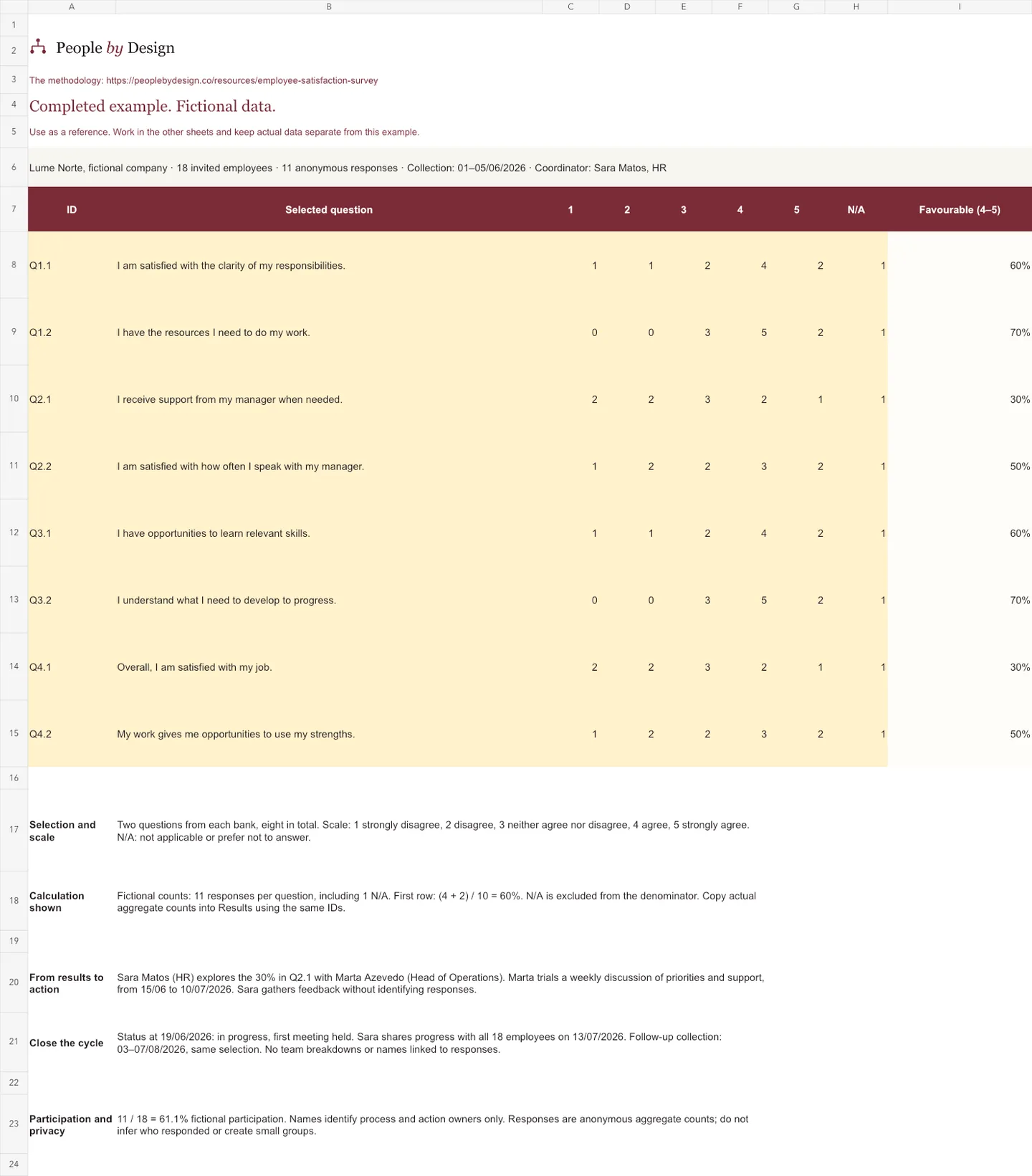
What it is and what it is for
An employee satisfaction survey explores how people evaluate their work experience and where improvement is needed. The kit’s 32 original questions cover work and resources, management and recognition, development and conditions, and overall experience. They are not a clinical instrument or validated psychometric scale.
Who uses it and when
HR or the listening owner designs collection and protects access. Managers and leaders need to be ready to discuss aggregate findings and own specific actions.
Suggestion: semiannual or annual, with a pulse after a material change or action. Repeat questions only when useful and when you can respond to what you learn.
How to use the template
- 1.Define the objective and invited population. Explain what you want to learn, how responses will be used and when results will be shared.
- 2.Start with 2–3 questions per section, roughly 8–12 total. For a pulse, use fewer questions about a specific change. Test actual duration.
- 3.Select Yes for relevant questions and adapt wording where needed. Copy Questionnaire into your collection tool, preserving IDs and N/A.
- 4.Configure access and privacy in the chosen tool. If adding an open question, remember that details can identify the respondent or colleagues.
- 5.Save a cycle copy. Enter aggregate counts by ID, including real zeros, and review distributions as well as favourable percentages. Choose 1–3 actions with an owner and date.
Data access and limitations
Do not promise anonymity just because you use this file or omit names. The tool, group size and comments matter. A percentage or average does not explain causes or replace listening. Do not collect unnecessary health or other sensitive data.
Common questions
Does Excel send the survey to employees?
No. It prepares a questionnaire to copy into your chosen tool. Collection, permissions and communication happen in that tool.
How is the favourable percentage calculated?
Responses 4 and 5 divided by valid responses 1–5. N/A is excluded. With no valid responses, the result stays blank. Review counts for each response option too.
References and use
These are practical People by Design resources. Suggested cadences and quantities are starting points, not universal standards. References consulted on 16 October 2026:
Adapt the workbook for internal use in your organisation. Preserve the source attribution. Avoid unnecessary personal data.
From template to implementation
If your challenge needs shared criteria, manager alignment and use in everyday routines, explore our work in this area.
Explore the related service