A look inside the workbook
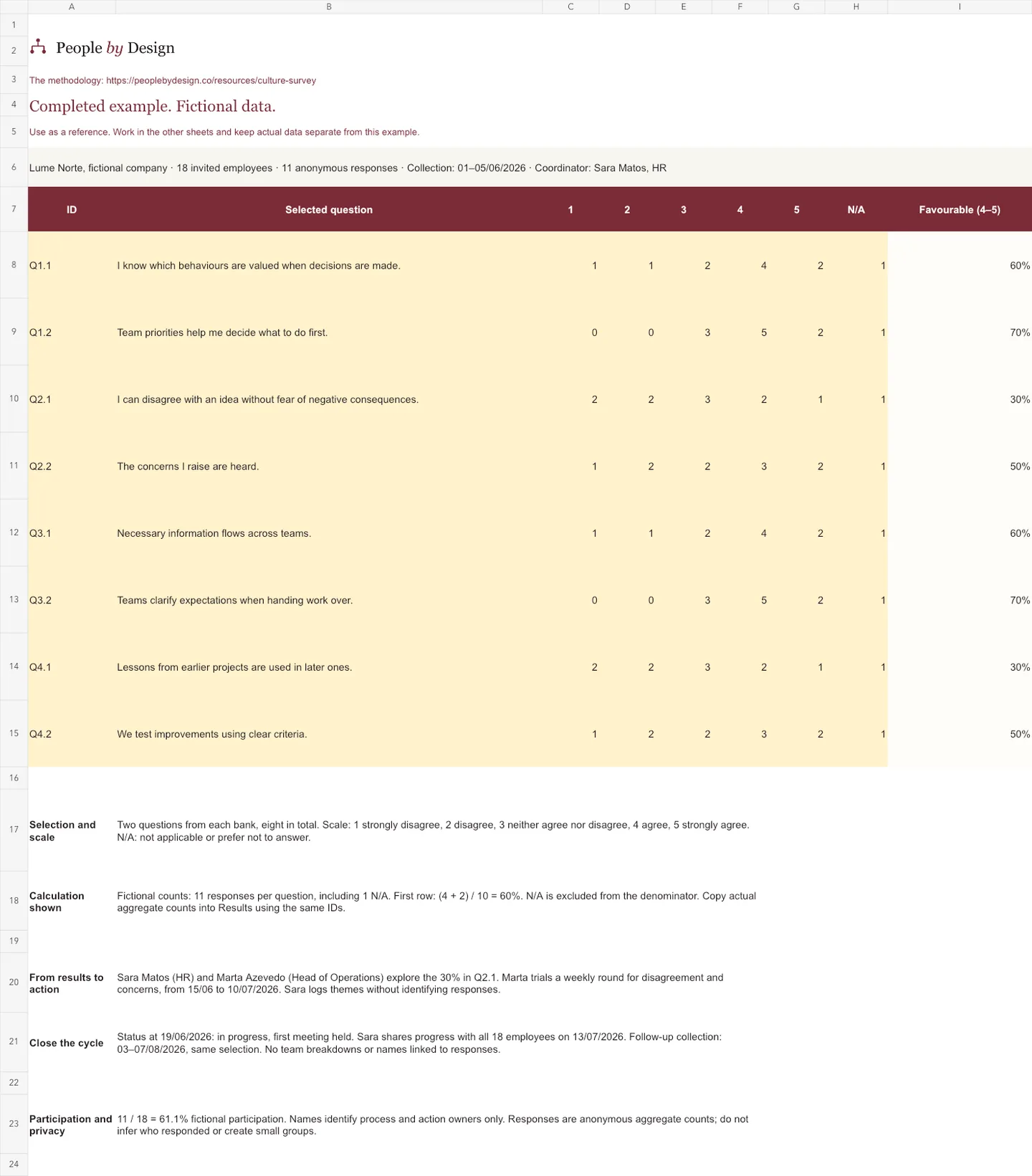
What it is and what it is for
A culture survey gathers perceptions of current behaviours and practices: decisions, trust, collaboration and learning. It does not itself define desired values or measure satisfaction in an equivalent way. This bank includes 32 original questions across four sections, with no claim of psychometric validation.
Who uses it and when
HR or the listening owner defines purpose and collection. Leaders commit to responding to results. Decide before launch who can see detailed data and who receives aggregates only.
Suggestion: semiannual or annual, with a focused pulse after action. Keep wording, scale and context consistent when comparing cycles; changing selection changes comparability.
How to use the template
- 1.Choose a decision purpose, such as understanding whether priorities and responsibilities are clear. Decide what you can do with answers.
- 2.Start with 2–3 questions per section, roughly 8–12 total, as a suggestion. For a pulse, choose 1–2 per priority objective. These are not quotas: remove questions you cannot act on.
- 3.Select Yes for chosen questions. Questionnaire brings them together to copy into your collection tool. It includes a 1–5 agreement scale and N/A.
- 4.Pilot with a small group and check comprehension and actual completion time. Configure privacy in the collection tool and explain purpose, access and retention.
- 5.Save a cycle copy and freeze selection before analysis. Enter aggregate counts by ID. The template calculates favourable responses (4–5), excluding N/A, and records actions.
Data access and limitations
This Excel builds a questionnaire and organises aggregates; it does not collect responses or guarantee anonymity. Small groups and free text can identify people. A disclosure threshold such as five responses does not guarantee anonymity. Sections are not validated scales and results do not prove causation.
Common questions
Are culture and satisfaction the same?
No. Culture looks at how people work and decide. Satisfaction looks at how people evaluate their experience. You can combine objectives, but keep questions and interpretation distinct.
How can I reuse the questionnaire?
Copy the final Questionnaire, preserve IDs and save one workbook per cycle. Do not change selection after entering counts, as this would compromise comparison with the questionnaire actually used.
References and use
These are practical People by Design resources. Suggested cadences and quantities are starting points, not universal standards. References consulted on 16 October 2026:
Adapt the workbook for internal use in your organisation. Preserve the source attribution. Avoid unnecessary personal data.
From template to implementation
If your challenge needs shared criteria, manager alignment and use in everyday routines, explore our work in this area.
Explore the related service